
Why an Empty Rack Unit Is Not Available Capacity
How Helixrack reviews space, power, cooling, network, operating reserve, and maintenance access before accepting hardware.
- Published
- Filed under
- capacity
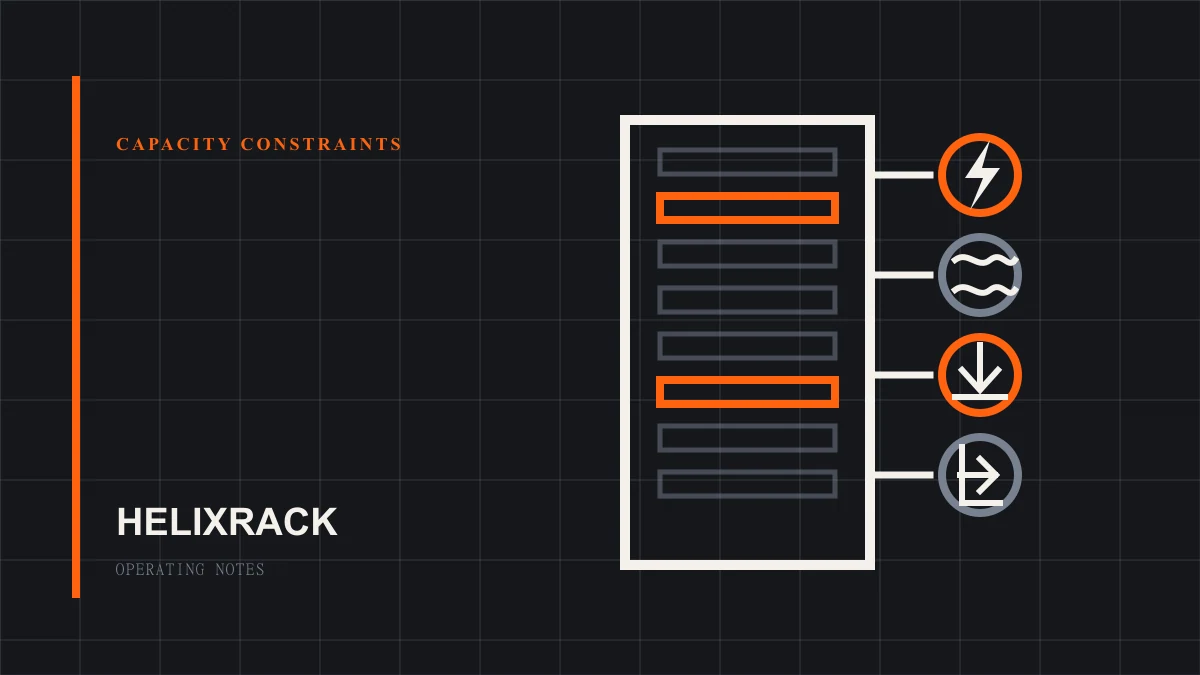
An empty rack unit is visible. Available capacity is the smaller set of positions where a specific machine can be powered, cooled, connected, handled, and maintained within the approved operating envelope.
That is why Helixrack asks for the hardware details before providing receiving instructions.
Space is the first check, not the last
Rack height does not capture chassis depth, rail compatibility, weight, cable bend radius, front and rear clearance, or the room needed to remove a failed component. Positions may also be reserved for switching, power distribution, staging, spares, or safe access.
A short-depth 1U server and a dense accelerator system can consume capacity very differently even if both fit between the same rack marks.
Operating reserve has a job
We also preserve room for ordinary changes and fault response. A layout that works only while every supply, circuit, cooling path, port, and cable stays exactly as planned leaves little room to maintain the service. Capacity review therefore considers the expected operating state and the conditions that matter during approved maintenance or a component failure.
Reserve is shared across several constraints, so it cannot be summarized by one empty-space number. A position may remain open because the nearby electrical or cooling envelope is committed elsewhere, because it protects access to installed equipment, or because it supports receiving and recovery work. Keeping that reserve available is part of operating the facility.
Power and cooling must agree
The review considers likely steady and peak draw, input voltage, power-supply configuration, feed requirements, and what happens to the surviving path after a supply or circuit change.
Cooling is reviewed at the expected operating load. Airflow direction, inlet conditions, exhaust path, nearby equipment, and available cooling reserve can change placement. A system that recirculates hot air or exhausts against the intended path may need another position or may not fit the current facility.
Network and maintenance are capacity
Port requirements, addressing, facility-side handoff, remote-management access, and cable routing need an approved path to the rack position. An open unit is not useful if the requested service cannot reach it cleanly.
Technicians also need enough room to identify the right chassis, inspect an indicator, replace an approved part, connect temporary test equipment, or remove the server without disturbing another customer’s hardware. Receiving and test positions must remain available so unreviewed equipment does not move directly into production.
What our capacity answer covers
A fit review returns a decision for the submitted configuration, not a general promise about the rack. We may confirm a suitable position, ask for missing specifications, propose a different power or network arrangement, or explain which requirement falls outside the current envelope.
That answer is tied to the hardware and assumptions in the request. If an accelerator, drive shelf, power supply, rail kit, or interface changes before delivery, send the revised configuration so we can check the placement again. The same applies to a later upgrade: physical ownership stays with the customer, while the facility has to approve changes that alter space, power, cooling, cabling, or handling.
Send the complete configuration
Include the manufacturer and model, dimensions, approximate weight, power-supply count, input requirements, expected draw, airflow direction, network ports, and any unusual access need. Photos of the chassis and data plate can help when a system has been modified.
Approval applies to the configuration reviewed. A different chassis, power supply, accelerator, or network request can require another check.
To request a fit review, send the complete configuration through Helixrack.com before arranging delivery.